Plumbing · Published 2026-11-16 · Updated 2026-11-16
How to stop a dripping tap: washer, O-ring or cartridge
A dripping tap wastes water, irritates everyone in the house and usually has a cheap fix. This guide shows how to find out which type of tap you have, what to replace and in what order, and when to stop and call a plumber. You will also see what the parts cost against a plumber's price.
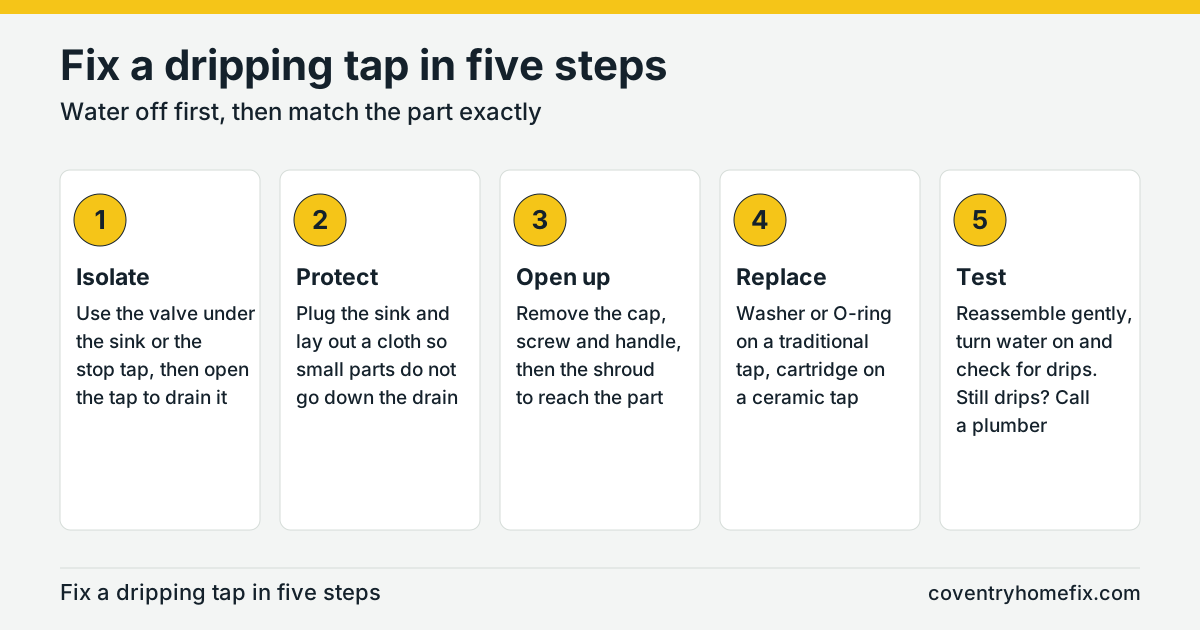
Quick answer. Turn off the water at the isolation valve or stop tap, open the tap to drain it, then take the tap apart. On a traditional tap, replace the rubber washer and check the O-ring. On a mixer or ceramic tap, replace the whole cartridge. Reassemble, turn the water on and test. If it still drips, call a plumber.
Why is my tap dripping?
Nearly every drip comes from a worn part inside the tap that no longer seals the water off. On a traditional tap that part is a rubber washer pressed against a seat. On a modern tap it is a ceramic disc or cartridge. Homebase, Hometree and AXA all describe the same pattern: parts wear, limescale builds up, and the seal fails.
A drip from the spout when the tap is closed means the washer or cartridge has failed. That is the most common case, and it is also the easiest to fix. A drip or weep around the base of the spout, or from the handle, usually points to an O-ring. Knowing which one you have is the whole job, so look before you buy anything.
What type of tap do I have?
Homebase gives a simple test. A traditional compression tap needs a full turn or more to reach maximum flow. A ceramic disc tap, usually a more modern design, reaches full flow in much less than a full turn. Hometree adds that monobloc taps, a single body mixer, tend to use a ceramic cartridge for each of hot and cold, and AXA lists monobloc lever taps as a separate type with a ceramic cartridge inside.
The table below sums up what each type needs, and it is worth reading before you shop for parts. None of the pages gives a foolproof visual guide, so if you cannot tell, take a photo of the tap and the old part to the shop and ask.
What tools and parts do I need?
Hometree and AXA list a short kit. You probably have most of it already. If you are tackling a ceramic tap, Homebase also mentions an Allen key for some retaining bolts. Buy the new part before you start only if you know the exact type, because valves differ in size and number of teeth. Homebase suggests taking the old valve to a local bathroom shop to match it.
- An adjustable spanner.
- Flat and cross head screwdrivers.
- Scissors or a small flat screwdriver to remove an old O-ring.
- A replacement washer and O-rings for a traditional tap, or a replacement cartridge for a mixer tap.
- A cloth or old towel, plus the sink plug so small screws cannot go down the plughole.
How do I turn off the water safely?
Look under the sink first. Hometree and AXA both say to use the isolation valve if there is one, usually a small slotted valve on the pipe to the tap. Turn it a quarter turn with a screwdriver. If there is no valve, you will need to shut off the stop tap, which is often under the kitchen sink or near where the pipe enters the house. Our guide on finding your stop tap shows where to look.
Open the tap afterwards and wait until the water stops. That drains the pipe so it does not flood the sink when you take the tap apart. Put the plug in the sink before you start. AXA also advises running the taps to drain the water before any plumbing work, which is a good habit whatever the job.
If the isolation valve will not turn, or water keeps running after you close it, do not force it. A seized valve is a plumbing problem in its own right, and it is cheaper to call someone than to break the pipe fitting. Keep a towel under the pipes while you test it.
How do I replace the washer on a traditional tap?
Follow the order below. Lay out the parts in the order they come off so you can rebuild them backwards.
- Remove the decorative cap or cover on the handle and unscrew the retaining screw underneath.
- Lift off the handle and any metal shroud, which exposes the valve body.
- Grip the valve with the spanner and unscrew it, then pull it out.
- Find the rubber washer at the bottom, prise it off and fit a new one that is an exact match.
- Refit the valve, shroud and handle, but do not over tighten, because AXA warns that it can cause damage.
What if it still drips after changing the washer?
The next suspect is the O-ring around the spout, or a damaged valve seat. For the O-ring, loosen the grub screw on the spout if there is one, lift the spout off, lever or cut off the old ring and slide on a new one. AXA and Hometree both describe this step.
Homebase warns that if the valve seat is worn, rough or scored, a new washer will not seal and replacing the valve is fiddlier. That is the point to ask a plumber. Our guide on what a plumber charges for a leaking tap shows that a complex valve seat repair is the top of the range.
How do I replace a ceramic cartridge?
Remove the hot or cold indicator cap, undo the screw or grub screw under it, and take off the metal shroud. Grip the cartridge with the spanner and twist it out. Note which side is hot and which is cold before you remove it, because cartridges are not interchangeable in some taps. Fit the new one and reassemble in reverse order.
Hometree stresses buying an exact replacement. If the cartridge you pull out will not come out, or the tap is old and corroded, a new tap may be the better move. A handyman can often do this work, as our handyman or specialist guide explains, and you can find a handyman in Coventry.
What does it cost to do it myself or hire someone?
Parts are cheap. Fantastic Services' 2026 guide lists a washer or O-ring at £1 to £5 and a ceramic cartridge at £10 to £30, including VAT. A plumber's repair for a washer or O-ring swap is £50 to £70 on the same guide, and a cartridge swap is £60 to £110. The worked table shows how the figures compare.
If you want a price for the whole job, see our guide on plumber costs for a leaking tap. For help near you, try plumbers in Foleshill or the main Coventry plumber directory.
When should I stop and call a plumber?
Stop if you cannot isolate the water, if parts are seized or corroded, if the leak is from a pipe and not the tap, or if you simply are not comfortable. Hometree and Homebase both say to call a professional if you are unsure. In the meantime, Hometree suggests catching the drips for plants or washing up.
Taps on a combination boiler hot water supply or connected to a gas appliance are not a place for guesswork, so read our Gas Safe checklist if there is any doubt about who should work on what.
At a glance
| Tap type | How to spot it | Part to replace |
|---|---|---|
| Traditional compression tap | Needs a full turn or more to reach full flow | Rubber washer, then O-ring if the spout leaks |
| Ceramic disc tap | Reaches full flow in much less than a full turn | Ceramic disc valve or cartridge |
| Mixer or monobloc tap | Single body with lever or two handles | Ceramic cartridge, hot and cold may be separate |
DIY parts against a plumber (Fantastic Services 2026, midpoints of ranges)
| Fault | DIY parts | Plumber, rest of UK | Worked difference |
|---|---|---|---|
| Washer and O-ring swap | Washer £3 + O-ring £3 = £6 | £50 to £70, midpoint £60 | £60 minus £6 = £54 saved |
| One cartridge | Cartridge £20 | £60 to £110, midpoint £85 | £85 minus £20 = £65 saved |
| Two cartridges on a pair of taps | 2 x £20 = £40 | 1.5 hours x £50 = £75 labour + £40 parts = £115 | £115 minus £40 = £75 saved |
Steps in order
| Step | What to do | Why |
|---|---|---|
| 1 | Isolate the water and drain the tap | Stops flooding when you open it up |
| 2 | Plug the sink and lay out a cloth | Stops small parts going down the drain |
| 3 | Remove the handle and shroud | Exposes the washer or cartridge |
| 4 | Replace the part with an exact match | A near match often still drips |
| 5 | Reassemble gently and test | Over tightening can damage parts |
This is general guidance, not legal advice. Rules and prices change, so check the official sources listed below.
Questions
Why does my tap drip when it is turned off?
A worn washer, ceramic disc or cartridge no longer seals the water. A drip from the spout points to that part, and a weep at the base points to the O-ring.
How much does a tap washer cost?
Fantastic Services' 2026 guide gives £1 to £5 for a washer or O-ring, including VAT. A ceramic cartridge is £10 to £30.
Do I need to turn off the water to fix a dripping tap?
Yes. Use the isolation valve under the sink if there is one, otherwise the stop tap. Our stop tap guide shows where to find it.
How do I know if it is the washer or the cartridge?
Traditional taps need a full turn or more and use a washer. Ceramic taps need far less than a full turn and use a disc or cartridge.
Can I use any washer?
No. Fit an exact match for size and shape. Hometree says to buy the exact replacement cartridge, and Homebase suggests taking the old part to a shop.
Why is my tap still dripping after a new washer?
The valve seat may be worn or scored, or the O-ring at the spout may be failing. A worn seat is a job for a plumber.
How long does it take to fix a dripping tap?
Most DIY repairs take under an hour once the water is off, but allow longer if parts are stiff with limescale.
How much does a plumber charge for a dripping tap?
Fantastic Services gives £50 to £150, with a typical £100, for 2026. See our leaking tap cost guide for the full breakdown.
Can a handyman fix a dripping tap?
Often yes for a washer or cartridge swap. Check their insurance and experience first, using our guide to hiring a handyman.
What should I do while waiting for the repair?
Hometree suggests collecting the drip water for plants or washing up. If water is escaping from a pipe, shut off the supply and call a plumber.
Sources
- Homebase, how to stop a dripping tap
- Hometree, how to fix a dripping tap (modified June 2026)
- AXA, how to fix a dripping tap
- Fantastic Services, dripping tap repair cost guide 2026
Keep reading
- What a plumber charges for a leaking tap
- Burst pipe and finding your stop tap
- Handyman or specialist
- How to hire a handyman
- Plumbers in Coventry
- Burst pipe: find your stop tap and what to do next
- Blocked sink: what to try before calling a plumber
- Why is my radiator cold at the bottom? Causes and fixes
- What does a plumber charge for a leaking tap in the UK?
- Boiler pressure too low: what to do and how to top it up
- Find a handyman in Coventry
- Find a plumber in Coventry
- How Coventry Home Fix works