Home maintenance · Published 2026-11-16 · Updated 2026-11-16
Why is my radiator cold at the bottom? Causes and fixes
If your radiator is warm at the top but stays cold along the bottom, you are not alone, and it is rarely the boiler. This guide explains the likely causes in the order to check them, what you can do yourself, and what a flush costs if the system needs one. You will also see how to tell this apart from trapped air.
Quick answer. A radiator that is hot at the top and cold at the bottom is usually blocked by sludge, a mix of rust and debris that settles low down. First check the thermostatic valve and the lockshield valve are open. If they are, bleeding will not help, and the fix is a chemical flush or powerflush, typically £75 to £700.
Why is my radiator cold at the bottom?
Hometree says sludge is almost always the cause when a radiator is hot at the top and cold at the bottom. Sludge is the rust, dirt and metallic debris that collects inside an older heating system. It is heavier than water, so it settles at the bottom of the radiator and restricts the flow there. Heatable gives the same explanation.
Do not confuse this with the opposite pattern. Trapped air makes a radiator cold at the top and hot at the bottom, and that is fixed by bleeding. Our guide on how to bleed a radiator covers that case, so check which way round yours is before you start.
What should I check first?
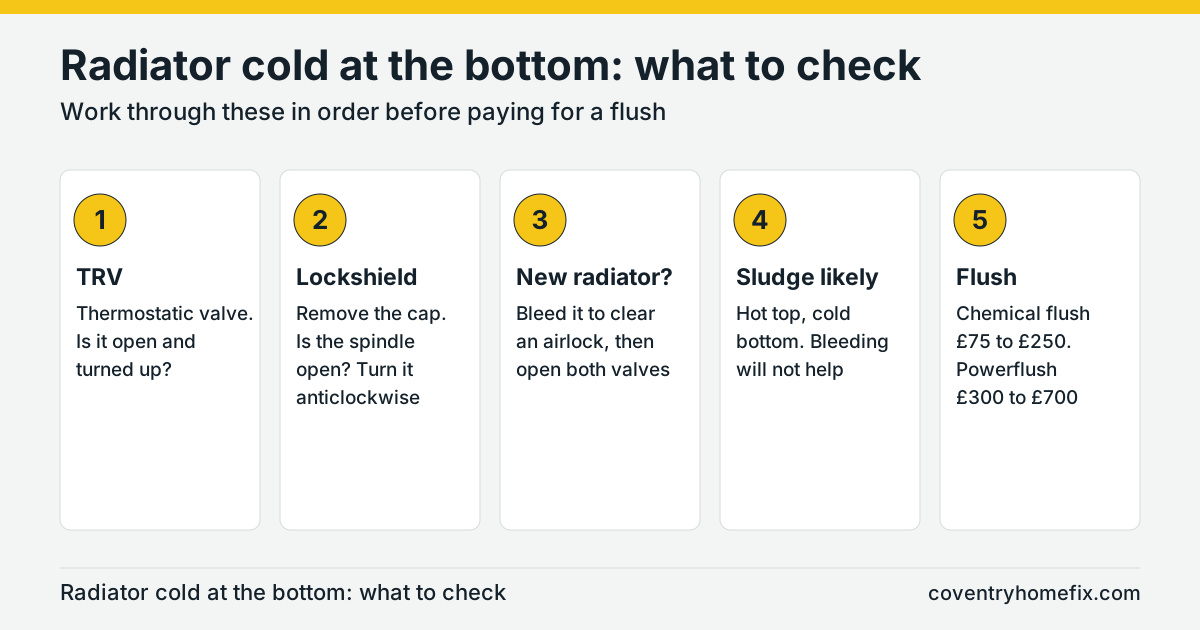
Work through the simple causes before you assume sludge. Hometree sets out an order that saves money, and it is worth following.
Start with the thermostatic radiator valve, the one on the side with the numbers. If it is stuck or turned right down, the radiator will not heat properly. Turn it up and give it time. Then check the lockshield valve on the other side, which usually has a plastic cap. If it was closed, for example while decorating, remove the cap and turn the spindle anticlockwise to open it.
- Check the thermostatic valve is open and turned up.
- Check the lockshield valve under the cap is open.
- If the radiator is new, bleed it to clear any airlock, then check both valves are fully open.
- If none of these apply, sludge is the likely cause.
- If every radiator is cold, suspect the boiler or pump first, as Heatable says. Our boiler troubleshooting guide is the place to start.
Will bleeding or balancing fix a sludge problem?
No. Hometree is blunt on this: you cannot fix a sludge blockage by bleeding or balancing the radiators. Bleeding lets air out. Balancing evens out the heat between rooms. Neither moves rust out of a radiator.
That said, bleeding is still worth doing if you have not done it for a year, and you should check the boiler pressure afterwards. If the pressure drops, our guide to boiler pressure that is too low shows how to put it right.
What is the difference between a chemical flush and a powerflush?
A chemical flush adds a cleaning chemical to the system, runs the heating for a while, then drains and refills. Hometree says it suits cold spots in one or two radiators or minor sludge. A powerflush uses a pump to force water through the whole system at speed, and Hometree says it suits a whole system problem. iHeat adds that a powerflush is for confirmed circulation problems, such as cold bottoms, slow warm up, noise or dirty water when bleeding, not a precaution.
Fantastic Services says a confident homeowner can attempt a DIY chemical flush, but it only clears light sludge. Heatable lists a DIY flush of one radiator, removing it and flushing it through, and describes it as a risky option. If you are not experienced, leave this to an engineer. Heatable also warns that powerflushing may split fragile older pipework, so ask the engineer to assess the system first.
How much does a flush cost?
The pages disagree a little, so use the ranges as a guide. Hometree gives £75 to £250 for a chemical flush, Heatable £100 to £200, and Fantastic Services £150 to £350. For a powerflush, Hometree says £300 to £700, Heatable £400 to £600 and Fantastic Services £400 to £700 including VAT, with an average near £575. London and the South East add roughly 20 to 30 per cent according to Fantastic Services.
The size of the house matters most. iHeat, updated 25 June 2026, splits the price by property: a flat or up to six radiators £300 to £400, a two or three bed home or seven to ten radiators £400 to £550, a four bed home or eleven to fifteen radiators £550 to £700, and 16 radiators or more from £700.
What else will the engineer add?
After cleaning, the engineer should add a fresh inhibitor to protect the metal. iHeat cites BS 7593 as the relevant guidance, and Fantastic Services says the inhibitor is usually included in a powerflush quote. Heatable lists an inhibitor at about £35 on its own.
A magnetic filter on the return pipe catches metal debris before it builds up again. Fantastic Services gives £120 to £250 for one outside London and the South East. Ask for the filter to be on the quote, because without it the sludge will return. The worked table below shows how it adds up.
How long does it take, and what can go wrong?
Expect most of a day. Hometree says six to ten hours depending on system size, and Fantastic Services says four to eight hours, longer for a large or heavily clogged system. You will have no heating while it is done.
A flush will not fix a faulty pump, a sticking valve or an airlock, as iHeat points out. If a radiator is still cold afterwards, ask the engineer to check those. Also tell them if your boiler is under warranty, since Fantastic Services notes that many manufacturers want a clean system.
What other signs point to sludge?
The cold bottom is the classic sign, but there are others. iHeat lists slow warm up, noise and dirty water when you bleed a radiator as signs of a circulation problem. If the water that comes out is black or brown, or the radiator takes a long time to heat even with the valves open, sludge becomes more likely. Heatable also suggests looking at the outside of old radiators for rust or corrosion, because a badly corroded radiator may need replacing and not just flushing.
Not every cold spot needs a big job. If only one radiator is affected and the rest are fine, a chemical flush or a single radiator clean may be enough. If several are patchy, the whole system is probably carrying debris, and a powerflush becomes the more sensible option. Either way, write down which radiators are cold and since when. That helps an engineer decide quickly, and it keeps the visit short, which keeps the bill down.
How can I stop sludge coming back?
Once the system is clean, the inhibitor and magnetic filter do the long term work. Fantastic Services says many manufacturers expect a clean system for the warranty, so keep the paperwork from the flush. Have the filter cleaned at each annual boiler service, and our boiler service cost guide shows what that visit should cost.
Who should do the work in Coventry?
Anything involving the boiler itself must be done by a Gas Safe registered engineer, so read our Gas Safe checklist and check the register yourself. Simple valve checks and bleeding you can do, and a handyman may help with that, see the handyman directory.
For flushes and boiler work, browse the Coventry plumber directory or look for plumbers in Finham and other areas. We list businesses but do not vet or recommend them. Get at least two written quotes that state what is included.
At a glance
| Symptom | Likely cause | What to do |
|---|---|---|
| Hot top, cold bottom | Sludge | Check valves, then chemical flush or powerflush |
| Cold top, hot bottom | Trapped air | Bleed the radiator |
| Cold all over, valves open | Stuck valve or circulation fault | Ask an engineer to check |
| All radiators cold | Boiler, pump or pressure | Check boiler first |
| New radiator cold | Airlock or closed valve | Bleed, then open both valves |
Powerflush price by property (iHeat, 25 June 2026)
| Property | Powerflush | Plus magnetic filter £120 to £250 | Total range |
|---|---|---|---|
| Flat or up to 6 radiators | £300 to £400 | £120 to £250 | £420 to £650 |
| 2 to 3 bed or 7 to 10 radiators | £400 to £550 | £120 to £250 | £520 to £800 |
| 4 bed or 11 to 15 radiators | £550 to £700 | £120 to £250 | £670 to £950 |
Flush options compared
| Option | Published range | Best for | Source |
|---|---|---|---|
| Chemical flush | £75 to £250 | One or two cold radiators, light sludge | Hometree, Heatable and Fantastic Services |
| Powerflush | £300 to £700 | Whole system problems | Hometree, Heatable, iHeat, Fantastic Services |
| Magnetic filter | £120 to £250 | Stopping sludge returning | Fantastic Services, 2026 |
| Inhibitor | About £35 on its own | Protecting metal after cleaning | Heatable |
This is general guidance, not legal advice. Rules and prices change, so check the official sources listed below.
Questions
Why is my radiator hot at the top and cold at the bottom?
It is almost always sludge settling at the bottom, according to Hometree. Check the valves first, then ask an engineer about a flush.
Can I fix a cold radiator bottom myself?
You can check the valves and bleed the radiator, but you cannot clear sludge that way. A confident DIYer can try a chemical flush, which Fantastic Services says only clears light sludge.
How much does a powerflush cost?
Published 2026 ranges are about £300 to £700, depending on house size. A two or three bed home is typically £400 to £550 on iHeat's figures.
How much is a chemical flush?
Between £75 and £350 depending on the guide. It suits one or two affected radiators.
Will bleeding the radiator help?
Not for sludge. Hometree says bleeding or balancing cannot fix a sludge blockage. See how to bleed a radiator for when it does help.
How long does a powerflush take?
Four to ten hours, per Fantastic Services and Hometree. Plan for no heating that day.
Do I need a magnetic filter?
It is recommended where appropriate. Fantastic Services gives £120 to £250 for one, and it stops debris building up again.
Could my boiler be the problem?
If every radiator is cold, yes. Heatable says to suspect the boiler. Our boiler checks guide lists what to look at first.
Can a powerflush damage old pipes?
Heatable warns it may split fragile older pipework. Ask the engineer to assess the system before agreeing.
Who can do the work?
Boiler work needs a Gas Safe registered engineer. Check the register using our checklist and use the Coventry plumber directory to compare quotes.
Sources
- Hometree, why is my radiator cold at the bottom (modified September 2026)
- Heatable, radiator cold at bottom
- iHeat, the real cost of powerflushing (updated June 2026)
- Fantastic Services, power flush cost guide 2026
Keep reading
- How to bleed a radiator
- Boiler pressure too low
- Boiler not working: what to check
- Gas Safe engineer checklist
- Plumbers in Coventry
- How to bleed a radiator: steps, tools and what to check after
- What does a plumber charge for a leaking tap in the UK?
- How to stop a dripping tap: washer, O-ring or cartridge
- Boiler pressure too low: what to do and how to top it up
- Find a handyman in Coventry
- Find a plumber in Coventry
- How Coventry Home Fix works