Gas and safety · Published 2026-11-16 · Updated 2026-11-16
Boiler pressure too low: what to do and how to top it up
Low boiler pressure is one of the most common reasons a heating system stops working, and the cause is often simple. This guide shows how to read the gauge, how to top the pressure up safely on a sealed system, and what it means if the pressure keeps falling. You will also see where to draw the line between a quick fix and a job for a Gas Safe engineer.
Quick answer. The gauge should read about 1 to 1.5 bar. If it falls below 1 bar, switch the boiler off, let it cool, open the filling loop valves until the needle reaches 1 to 1.5 bar, close them and restart. If it keeps dropping, suspect a leak or fault and call a Gas Safe engineer.
What should my boiler pressure be?
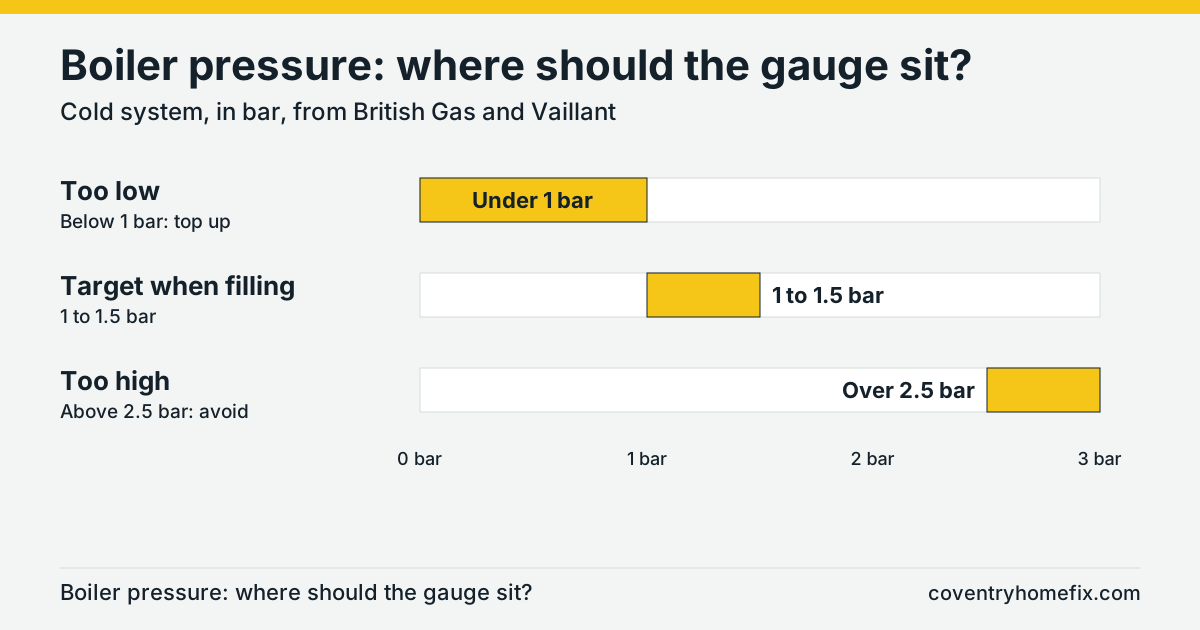
Most modern combination boilers and sealed systems have a pressure gauge on the front or underside. British Gas says the gauge should ideally read between 1 and 1.5, and Vaillant gives 1 to 1.5 bar too. Both say that below 1 bar is too low. Checkatrade agrees, and Worcester Bosch describes the gauge dropping into the red.
Vaillant also says to avoid going over 2.5 bar. Read the gauge before the heating comes on, and check it again after the boiler has reheated, as Vaillant advises. The manual for your own model has the final word, because systems differ.
Why has my boiler pressure dropped?
British Gas and Checkatrade both name two main causes. The first is a leak somewhere in the heating system, from a pipe, a radiator valve or the boiler itself. The second is bleeding a radiator, because air leaves and the pressure falls. Vaillant adds that the pressure may not have been set correctly after maintenance or repair work.
If you bled a radiator recently, low pressure is expected and you simply need to top it up. Our guide on how to bleed a radiator includes the pressure check. If you did nothing and the pressure has dropped, look for damp patches or drips around pipes, radiators and the boiler, as British Gas suggests.
What are the signs of low pressure?
The gauge is the clearest sign, but the boiler may also show a fault code, stop heating the radiators or lock out altogether. Our guide on what to check when your boiler stops working lists the other common causes, so check it if the gauge looks normal.
How do I top up the pressure with a filling loop?
Many boilers use an external filling loop, a flexible pipe with a valve at each end. British Gas says to check the manufacturer's booklet first, because processes differ. Vaillant gives a careful version of the steps, and the order below combines both.
Add the water slowly, as Vaillant warns that opening valves too fast can overfill the system. If the needle goes past 1.5 bar, do not panic. Checkatrade and Vaillant both say you can release some by bleeding a radiator.
- Switch the boiler off and let it cool. Checkatrade says to leave at least four hours.
- Find the filling loop and check both ends are securely attached.
- Make sure the system is not circulating water before opening anything, as Vaillant advises.
- Slowly open both valves so cold mains water enters the system, watching the gauge.
- Close both valves, one after the other, when the gauge reads 1 to 1.5 bar.
- Switch the boiler back on, press reset if needed, and check the gauge again once it has heated.
- Check the valves for drips, and remove the loop if it is detachable.
What if my boiler has a key or a lever instead?
Worcester Bosch describes three versions. An external loop with two valves is filled until the gauge shows just about one bar. A keyed internal loop uses a filling key kept in a flap under the boiler, which is pushed into the port, turned to the open padlock mark, then turned back when the pressure is just over one bar. A keyless version has a blue lever at the bottom of the boiler that you pull down until the pressure is over one bar, then release.
Checkatrade describes a similar key method and says to wait for 1.5 bar. Because the numbers vary, follow your own manual if it differs. If you cannot find the key or the manual, do not guess. A heating engineer can show you in minutes, and the Coventry plumber directory lists local businesses who say they do boiler work.
Is it safe to do this myself?
Worcester Bosch says repressurising can be done without a heating engineer, and British Gas and Checkatrade give homeowner steps. Both British Gas and Checkatrade also say that looking inside the boiler is a job only for a Gas Safe engineer. Topping up a sealed system is on the outside, but anything beyond that is not.
Read our Gas Safe checklist before anyone opens the boiler casing, and use the register to check the engineer. If you smell gas, leave the building and call the gas emergency number from outside. That is not a job for a filling loop.
How often is too often?
No page gives a fixed number, but Vaillant says repressurising should not be a frequent task. A small drop over several months can be normal wear. If you need to top up weekly, or the pressure drops back within days, you probably have a leak or a faulty part. British Gas says to book an engineer if you find a leak, and also if you find none and the problem continues.
Keep a note of the date and the gauge reading each time you top up. That record helps an engineer find the cause faster, and it keeps the visit short. If the system has not been serviced, ask whether the annual visit could include a pressure check. Our boiler service cost guide shows what to expect to pay.
What should I do after topping up?
Check the gauge again once the boiler has run and reheated, because Vaillant says the pressure should stay steady while it runs. Walk round the radiators and feel that they heat evenly. Then look at the filling loop valves and the joints under the boiler for drips, since a slow drip there is a common reason for repeat pressure loss.
If the heating works and the gauge holds, that is the end of it. If the boiler still shows a fault, or the pressure falls again within days, stop topping up and book an engineer. Repeated refilling can hide a leak that is getting worse. A cold radiator bottom can also show up after refilling, and our guide on a radiator that is cold at the bottom explains why.
Who can help in Coventry?
For a keyed or concealed filling system, a leak or repeated pressure loss, use the plumber directory to find engineers, or look at plumbers in Walsgrave and nearby areas. We list businesses but do not vet or recommend them, so ask for the Gas Safe number and check it. If the problem is a dripping radiator valve or a loose fitting, a handyman might do the small job, but gas and boiler work stays with the registered engineer.
At a glance
| Gauge reading | What it means | What to do |
|---|---|---|
| Below 1 bar (red zone) | Too low (British Gas, Vaillant, Checkatrade) | Top up with the filling loop |
| 1 to 1.5 bar, cold | Normal target when filling | Leave alone |
| Over 1.5 bar after filling | Slightly high | Bleed a radiator to release some |
| Above 2.5 bar | Too high (Vaillant) | Bleed a radiator, call an engineer if it stays high |
Worked examples of how much to add (readings are assumptions)
| Start reading | Target | Pressure to add | Working |
|---|---|---|---|
| 0.8 bar | 1.2 bar | 0.4 bar | 1.2 minus 0.8 = 0.4 |
| 0.5 bar | 1.5 bar | 1.0 bar | 1.5 minus 0.5 = 1.0 |
| 2.5 bar | 1.5 bar | Release 1.0 bar | 2.5 minus 1.5 = 1.0 |
Filling methods by boiler type (Worcester Bosch, British Gas, Checkatrade, Vaillant)
| Method | How it works | Stop at |
|---|---|---|
| External filling loop | Open both valves slowly | 1 to 1.5 bar |
| Keyed internal loop | Use the key, turn to open padlock mark | Just over 1 bar (Worcester Bosch), 1.5 bar (Checkatrade) |
| Keyless lever | Pull the blue lever down, then release | Over 1 bar (Worcester Bosch) |
| Cooling time before starting | Switch off first | At least 4 hours (Checkatrade) |
This is general guidance, not legal advice. Rules and prices change, so check the official sources listed below.
Questions
What should boiler pressure be?
About 1 to 1.5 bar when cold, according to British Gas and Vaillant. Below 1 bar is too low, and Vaillant says to avoid going above 2.5 bar.
How do I increase boiler pressure?
Switch off, let it cool, then open the filling loop valves slowly until the gauge reaches 1 to 1.5 bar. Close both valves and restart the boiler.
Why does my boiler pressure keep dropping?
A leak is the most likely cause, or a faulty part. Vaillant says repressurising should not be frequent, so book an engineer if it keeps falling.
Does bleeding radiators lower boiler pressure?
Yes. British Gas and Checkatrade both say air leaves the system, so top up afterwards. See our bleeding guide.
Can I repressurise my boiler myself?
Worcester Bosch says it can be done without an engineer, but only on the outside. Opening the boiler needs a Gas Safe engineer, as British Gas and Checkatrade say.
How long should I wait for the boiler to cool?
Checkatrade says at least four hours before topping up. British Gas and Vaillant say to let it cool without giving a time.
What if the pressure is too high?
Vaillant says above 2.5 bar is too high. Bleeding a radiator can bring it down, and a persistent high reading needs an engineer.
Is low pressure dangerous?
Low pressure on its own is a heating fault, not a gas leak. If you ever smell gas, leave the building and call the gas emergency number from outside.
How much does an engineer cost for low pressure?
None of the pages we read gave a fixed price. See the plumber directory for quotes and our boiler service guide for related costs.
How do I check my engineer is registered?
Use the Gas Safe register and read their ID card. Our Gas Safe checklist explains each step.
Sources
- British Gas, how to repressurise your boiler
- Worcester Bosch, boiler pressure
- Checkatrade, how to repressurise a boiler (updated March 2023)
- Vaillant, repressurising a boiler
Keep reading
- Boiler not working: what to check
- How to bleed a radiator
- Gas Safe engineer checklist
- How much does a boiler service cost
- Plumbers in Coventry
- Do you need a Gas Safe engineer?
- Boiler not working? What to check before calling an engineer
- Why is my radiator cold at the bottom? Causes and fixes
- What does a plumber charge for a leaking tap in the UK?
- How to stop a dripping tap: washer, O-ring or cartridge
- Find a handyman in Coventry
- Find a plumber in Coventry
- How Coventry Home Fix works